

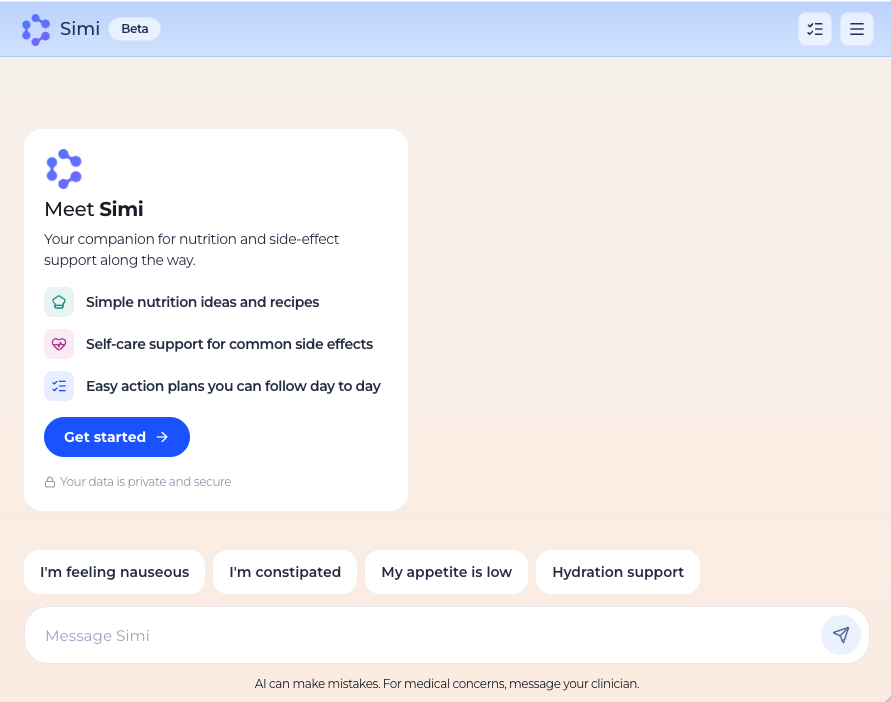
One of the things I love about telehealth is that it changes what’s possible.
At Simple, we’ve built a service that lets members start their weight loss journey from home. They complete an online assessment, our clinicians review every case, and, when appropriate, treatment is prescribed and delivered directly to their door. It’s healthcare designed around people’s lives, not waiting rooms.
But telehealth introduces a different challenge. Once treatment begins, life happens. You’re making dinner and suddenly realise you don’t feel hungry. You’re dealing with nausea after your injection. Your weight hasn’t moved for a week and you’re wondering whether that’s normal. Or you’ve simply had a difficult few days and need help getting back on track.
Starting weight loss medication is harder than most people expect, and it can be lonely. The questions that matter most rarely arrive during an appointment. They arrive at 9pm on a Tuesday, when nobody’s there to ask.
Most of these moments don’t require a clinical intervention. They do deserve support.
As we started thinking about the next evolution of our platform, I kept coming back to one question: how do we make digital healthcare feel like there’s someone there when you need them?
That’s where Simi began.
We didn’t want another chatbot
When AI exploded over the past couple of years, every product seemed to add a chatbot. Many are impressive. Most are also forgettable: you ask a question, they generate a well-written answer, and the conversation ends.
I didn’t want us to build that. As CPTO, I was far more interested in whether AI could actually help someone through a difficult moment than whether it could produce another beautifully written paragraph.
Very early on, we settled on a single design principle:
Every conversation should end with a useful next step.
If someone asks what to eat because they’re feeling nauseous, don’t explain nausea. Recommend gentle foods. Suggest one of our approved recipes. Create a hydration plan. Offer a few realistic actions for today, then check back later to see whether they actually helped.
Everything else in Simi’s design falls out of that principle. The right answer often isn’t another paragraph of AI-generated text; it’s the right information, in the right format, at the right moment. So alongside natural conversation, Simi has a growing toolbox of purpose-built experiences: recipe cards, structured action plans, side-effect guidance, hydration strategies, and practical next steps tailored to the member.
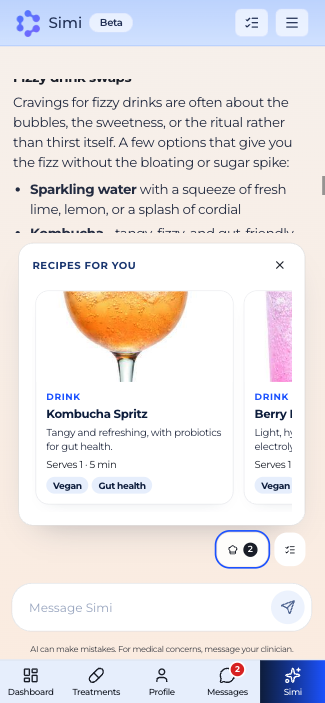 Sometimes the best answer is a recipe card, not a paragraph. Simi surfaces approved recipes directly in the conversation, tailored to dietary preferences and symptoms.
Solving real problems, not hypothetical ones
We didn’t start with a blank sheet of paper. We started with the questions people actually ask:
- How do I get enough protein when I’m barely hungry?
- Why has my weight stalled?
- What should I eat around injection day?
- Can you help with constipation?
- I’ve had a bad week. How do I get back on track?
These conversations happen every day during a weight loss journey. They’re rarely clinical, they’re often emotional, and they’re almost always practical.
And we didn’t guess at them. We worked closely with our clinical and nutrition experts to understand the conversations they have directly with patients, and we pored over real transcripts of those interactions to see how they actually unfold. Those transcripts became our golden examples: the reference conversations we use to shape how Simi should respond, what to prioritise, and when to hand back to a human.
Rather than building a general-purpose AI assistant, we deliberately constrained Simi’s scope. She focuses on nutrition, hydration, side-effect support, recipes, meal planning, behaviour change and helping members build sustainable habits. That focus makes her significantly more useful. She goes deep on the problems that actually come up, instead of shallow on everything.
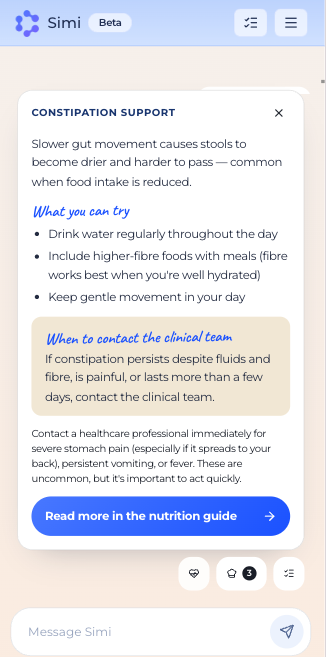 A structured action plan: brief reassurance, practical steps, and (built into every plan) clear guidance on when to contact the clinical team.
Personal without being invasive
Good AI needs context. Without it, every answer feels generic. With too much, you’re sharing information the model doesn’t actually need.
Finding that balance became one of the most interesting engineering challenges. Simi understands enough about a member to make conversations feel personal: where someone is in their treatment journey, their medication, dietary preferences, recent side effects, or a summary of their weight trend. At the same time, we’ve deliberately designed our architecture to minimise the personally identifiable information exposed to language models.
Every piece of context has to justify why it’s there. Our goal wasn’t to give the model everything; it was to give it exactly what it needs to help.
To achieve that, we built a context orchestration layer that assembles each conversation dynamically. Rather than passing an entire member record to the model, Simi constructs a focused view of the information relevant to the question being asked, combining structured member data with trusted nutrition guidance and product capabilities. A question about protein doesn’t need a weight history. A question about a plateau does, but as a compact trend summary, not raw records. And where the underlying data is noisy or inconsistent, Simi is designed to say so rather than over-interpret it.
This keeps responses personalised while reducing unnecessary exposure of sensitive information. It also gives us much tighter control over what the model sees, why it sees it, and how it reaches its answer.
AI needs boundaries
Healthcare AI carries a very different responsibility from most consumer applications. It’s not enough to produce a plausible answer; the answer has to stay within safe, clearly defined boundaries.
From day one, Simi has been designed with those guardrails built in. She doesn’t diagnose medical conditions. She doesn’t recommend changing medication. She doesn’t advise increasing doses, skipping injections or switching treatments. She doesn’t set target weights or calorie goals. Those decisions belong to our clinicians.
Instead, Simi focuses on everything around treatment: nutrition, hydration, side-effect management, behaviour change and helping members build healthy routines.
When a conversation moves into territory requiring clinical judgement (persistent or worsening symptoms, questions about doses, red-flag signals), Simi deliberately steps back and directs members towards our clinical team, or in extreme cases towards more immediate care. You can see this in the action plan above: escalation guidance isn’t an afterthought, it’s part of the format itself.
Stepping back isn’t the end of the story. When Simi escalates, the conversation is surfaced to our clinical team, who review what happened and decide how to follow up with the member. Simi supports people between those touchpoints; she doesn’t stand in for the clinicians behind them. Neither too early nor too late is the bar we hold her to: we routinely audit escalations to check she is handing over at the right moments, and we feed what we find back into how she behaves.
One of the most important things we built wasn’t teaching Simi what to answer. It was teaching her what not to answer.
Building trust into the platform
People often assume AI is mostly about choosing the right model. In reality, that’s a small part of the engineering effort.
Simi combines structured member context, curated nutrition guidance, retrieval systems and orchestration to generate responses grounded in trusted information. Different capabilities come into play depending on the conversation. A recipe request, a symptom, a wobble in motivation all take different paths through the system.
Concretely, that means two things. Before any change ships, and periodically in production, Simi’s responses run through evaluation suites that test them against real scenarios, including safety boundaries, side-effect guidance and nutrition accuracy. And every interaction is traceable: we can see what context was assembled, what guidance was retrieved, which capability responded, and whether an escalation rule fired. That lets us ask the questions that matter: did the escalation trigger when it should have? Did the member accept the plan? Did the follow-up land? Building AI this way isn’t a one-off project; it’s an ongoing loop of learning, measuring and refining.
We’re working towards alignment with ISO/IEC 42001, the international standard for AI management systems: human oversight, auditability, risk management and continuous improvement treated as core architectural principles rather than compliance exercises added later.
For healthcare, trust isn’t a feature. It’s the foundation everything else is built on.
More than a conversation
One of my favourite parts of Simi isn’t answering questions at all. It’s following up.
If someone has been struggling with hydration or nausea over the past few days, Simi checks in: has the vomiting settled? Are you managing to keep fluids down? Did those suggestions help?
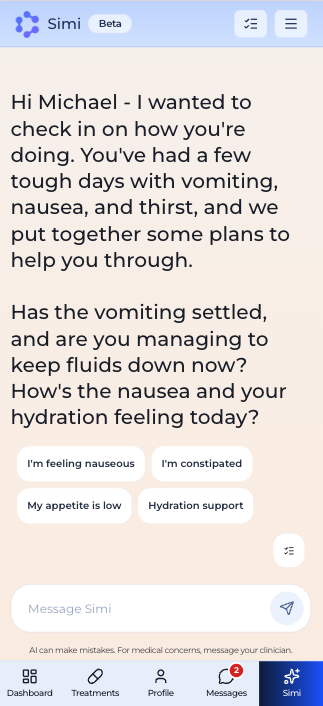 Simi following up after a rough patch, referencing the plans already in place, and making it one tap to continue the conversation.
It’s a small detail, but it changes how the experience feels. Less like software. More like someone genuinely supporting you through your journey.
This is only phase one
Today, Simi focuses on nutrition, hydration, side-effect support and the everyday questions that come with starting treatment. That focus has been deliberate. Rather than building an AI that does everything, we’ve concentrated on solving one problem exceptionally well: making sure members never feel like they’re navigating treatment alone. She’s currently in beta with members, and their feedback is directly shaping how she evolves.
But this is only the beginning. We’re already working on the next generation of Simi: expanding her capabilities, making support more proactive, and integrating AI thoughtfully across the whole member journey.
I believe the future of telehealth isn’t more appointments. It’s intelligent, personalised support that’s available whenever you need it, and that knows exactly when to bring a clinician into the conversation.
Starting weight loss medication is hard. There are tough days, strange symptoms, stalled weeks and moments of doubt. If Simi can make even one of those days a little easier, we’ve built something worthwhile.
And we’re only just getting started.